
PCB Materials and Types

Uniting Strength & Flexibility for Advanced Electronics


Comprehensive PCB Materials and Types for Every Application
The performance of Printed circuit board (PCB) depends heavily on the substrate material, which must provide mechanical strength, thermal stability, dielectric reliability, and resistance to environmental and chemical factors. The right material ensures signal integrity, minimizes crosstalk, and supports both long-term reliability and cost-efficiency.
At HT Global Circuits (HTGC), we manufacture a wide range of PCBs using carefully selected substrates and laminates tailored to the specific needs of each board type and application, delivering consistent performance and durability across diverse industries. Explore our PCB material’s list to find the ideal solution for your requirements.
Why PCB Material Selection Matters

Certain material properties are integral to the board’s performance. Here are some reasons why selecting the right PCB material is significant for the board’s performance.
- Dielectric constant (Dk): This factor significantly affects signal propagation speed and impedance control. A low dielectric constant ensures fast signal transmission, making it particularly useful for high-frequency applications.
- Loss tangent: Loss tangent, denoted as Df, determines the amount of signal energy dissipated as heat within the material. Lower loss tangent values are crucial for high-speed digital and RF applications where signal integrity is paramount. Even small variations in loss tangent can significantly impact signal quality over long trace lengths.
- Thermal Management (Tg, CTE, Td): The Glass Transition (Tg) and Decomposition Temperature (Td) define operational limits. The Coefficient of Thermal Expansion (CTE) must be matched to your components to prevent solder joint fracture during thermal cycling. High-Tg FR-4 (Tg > 170°C) and polyimide (Tg > 250°C) for harsh environments.
- Cost impact: Choosing a material unsuited to the application requirements would impact the budget, and may be a waste. For instance, while standard FR4 is widely used for general applications due to its balance of properties, it may not be suitable for high-frequency applications. On the other hand, using expensive materials such as Rogers may add to the costs of the project when not required. So, it is important to understand performance-to-cost ratio vis-à-vis specific application requirements.
Our PCB Materials List
Here are some common PCB laminate materials and PCB substrate materials we use depending on the application requirement.

| Material | Type | UL Approved | Flammability UL94 | Glass Transition Temp (Tg Celsius) | Decomposition Temp By TGA (Celsius) | Dielectric Constant (Dk 1 GHz) | Loss Tangent (Df 1 GHz) |
|---|---|---|---|---|---|---|---|
|
FR4 |
Standard (high-Tg) |
Yes |
V-0 |
170 |
300 |
3.95 |
0.016 |
|
Polyimide |
Flex (high temperature) |
Yes |
V-0 |
250-400 |
|
3.3
@10GHz
|
0.01
@10GHz
|
|
Rogers |
RF |
Yes |
Yes |
280 |
|
3.38
@10GHz
|
0.0027
@10GHz
|
|
Isola |
High TG Epoxy (RF),
For ultra high-speed digital applications
|
Yes |
V-0 |
180 |
340 |
4.04
@2GHz
|
0.021
@2GHz
|
|
Megtron |
RF, For ultra high-speed digital applications |
No |
Yes |
185 |
410 |
3.63
@10GHz
|
0.004
@10GHz
|
|
Metal Core |
Aluminum |
Yes |
V-0 |
120-130 |
380 |
4.8
@1MHz
|
0.016
@1MHz
|
|
Ceramics |
Aluminum oxide (Al2O3) and aluminum nitride (AlN), For thermal conductivity and dimensional stability |
Content |
Content |
>1000°C |
Content |
8.6-9.0 @ 1 MHz |
0.0001 |
PCB Types by Material Application
HT Global Circuits manufactures a broad range of PCBs, including rigid, flex, rigid-flex, HDI, and hybrid builds, where material selection is closely aligned with thermal stability, electrical performance, and mechanical requirements. Here, we outline how various materials are matched to board structures to achieve optimal performance.
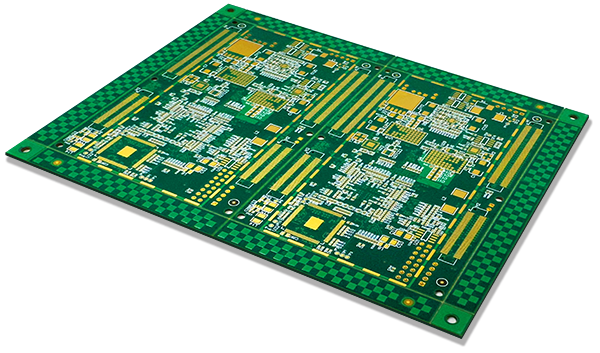
Rigid PCBs
Rigid boards utilize solid substrate materials that maintain their shape under normal handling and operating conditions. FR4 is the most widely used material for rigid PCBs due to its excellent mechanical properties and cost-effectiveness. High-performance rigid PCBs may utilize specialized materials such as Rogers or Megtron for demanding applications.

Flex PCBs
Polyimide or polyester substrates that allow bending and flexing during use find application in flexible PCBs. These materials maintain electrical continuity while accommodating mechanical movement. Flexible PCBs enable compact designs and eliminate the need for connectors in many applications. Their flexibility helps conform to the shape of the device.

Rigid-Flex PCBs
Rigid-flex PCBs combine the properties of rigid and flexible boards in a single assembly, utilizing multiple material types optimized for each section. The rigid sections typically use FR4 or specialized materials for component mounting, while flexible sections use polyimide for interconnection flexibility. This increases performance, efficiency, and dimensional stability.

High-Density Interconnect (HDI) PCBs
HDI PCBs require materials with excellent dimensional stability and fine feature capabilities. Modified FR4 materials or specialized low-Dk materials enable the fine trace widths and via structures essential for HDI designs. We help select the right material, which is crucial as it impacts the achievable trace density and electrical performance.

Hybrid PCBs
This is where our expertise delivers immense value. We strategically place expensive, low-loss Rogers or Megtron materials only for critical RF or high-speed digital layers, while using cost-effective FR-4 for power and general routing. This approach can optimize your BOM cost by 20-40% without sacrificing performance. Hybrid PCBs incorporate multiple material types within a single layer stack up to optimize performance for specific functions.
Why Do Engineers Choose HT Global Circuits?
With our expertise in materials, HT Global Circuits offers high-performance PCB solutions for mission-critical applications in aerospace, automotive, medical, telecommunications, and industrial sectors. Here are some reasons why OEMs prefer to partner with us for their material selection process.
- Advanced manufacturing techniques: Our advanced capabilities include custom stackup design and impedance modeling using industry-standard simulation tools. We optimize layer stackups to achieve target impedance values while minimizing cost and maximizing manufacturability.
- Variety in materials: We work with a range of materials and have developed expertise in selecting the right combinations depending on the application requirements. We partner with top laminate suppliers and have a robust vendor and supply chain network. This makes material and part procurement easy.
- Expertise in ultra-thin cores and flexible substrates: Materials need to be selected based on the desired thickness. We have the capability of using ultra-thin cores, which enables us to reduce the overall thickness. We work with advanced materials for specific or high-heat applications to improve thermal management. We can manufacture ultrathin cores for both rigid-flex and flexible boards.
- Certifications: We adhere to the leading industry standards and environmental regulations to ensure reliability and global market acceptance. Our materials meet IPC-4101 requirements for electrical, thermal, and mechanical properties, with full qualification data maintained for traceability. We hold UL Recognition for all standard materials, ensuring safety and reliability through rigorous flammability and electrical safety testing. Additionally, our processes are fully compliant with RoHS and REACH regulations, reinforcing our commitment to environmental responsibility and regulatory compliance.
- Strong focus on quality: Our commitment to quality is also reflected in our rigorous testing and inspection process. We utilize automated optical inspection (AOI) and x-ray inspection systems to detect design issues and hidden solder joint and internal structural defects in microelectronics printed circuit boards. This capability enables us to identify defects in ultra-thin boards manufactured from a wide range of materials.
Frequently Asked Questions

The key factors include operating frequency, temperature requirements, mechanical constraints, environmental conditions, and budget. For high-frequency applications, consider materials with low dielectric constant and loss tangent such as Rogers or Megtron. For high-temperature environments, polyimide or high-Tg FR4 are preferred. Always balance performance requirements with cost considerations.
Polyimide offers exceptional thermal stability, with operating temperatures up to 200°C+. They offer excellent flexibility for flex PCBs, low outgassing for space applications, and superior chemical resistance. Hence, they find application in aerospace, automotive, and medical that require precision, reliability and temperature performance.
Choose Rogers materials for applications that require the following:
- Operating frequencies above 1 GHz
- Precise impedance control (±5% or better)
- Low signal loss requirements
- Stable electrical properties across temperature and frequency
- Critical timing requirements in high-speed digital circuits as Rogers materials typically cost 3-10 times more than FR4 but provide superior RF performance
This is a perfect case for a hybrid stack-up. We can design a stack-up that uses Rogers RO4350B for your RF front-end and antenna layers, while employing a lower-loss FR-4 variant like FR408HR or Megtron for the high-speed digital lanes. This strategy harnesses the best of both worlds: guaranteed RF performance and significant cost savings.
Immediately. The stack-up is the first and most consequential decision in your board’s lifecycle. Engaging us during the schematic capture phase enables us to run stack-up simulations and provide a DFM report that can prevent costly respins, ensuring your design is optimized for performance, reliability, and cost from the outset.