
Microelectronics PCBs

Uniting Strength & Flexibility for Advanced Electronics


Microelectronics PCBs are highly advanced circuit boards designed with miniature components, multiple layers, fine traces, ultra-thin films, and stacked vias to achieve high interconnect density. These boards feature precise, 25-micron fine lines, 1 Mil thin-film build-ups, and laser-drilled micro-holes.
Unlike regular PCBs, microelectronics PCBs are used in next-generation electronic systems, powering mission-critical applications in industries like semiconductors, medical, defense, and industrial sensing. As a microelectronics PCB manufacturer, we offer advanced microelectronics PCBs, thanks to our 36+ years of PCB manufacturing experience for mission-critical systems.
Our Microelectronics Circuit Board Fabrication Capabilities
These are some advanced capabilities based on which we offer customized microelectronics PCB Solutions.

| Specification | Capabilities |
|---|---|
|
Number of layers |
FR4- 1-108
Flex- 1-10
Rigid-Flex- 1-24 |
|
Minimum dielectric
thickness |
Standard- 0.05mm Advanced- 0.025mm |
|
Line/space |
25µm |
|
Microvia drilling |
Stacked, staggered, via-in-pad |
|
Substrate thickness |
<50µm |
|
Technical capabilities |
Multilayer builds with sequential lamination |
|
Surface finishes |
ENIG, ENEPIG, OSP |
|
Minimum drill hole size |
Laser- 0.05mm 2mil CNC- 0.10mm 4 mil |
|
Cutting-edge technical
capabilities |
HDI, microvia, via-in-pad, flex, and metal core |
|
Controlled impedance |
Tight tolerances (±5%) |
|
Scalability |
Prototype to production scalability |
|
Certifications |
ISO 9001:2015 ITAR UL 94V-0 UL-C MIL-PRF-31032 AS9100D ISO 14001 IATF 16949 RoHS |
Advantages of Microelectronics PCBs

This technology has evolved significantly over the years, particularly since the inception of Industry 4.0. Here are some advantages of these boards, especially in high-density, modern electronics.

Ultra-compact design support
These boards enable significant miniaturization, making them perfect for compact and constrained spaces. The small form factor design support has enabled the integration of multiple functions into single, small form-factor devices.

High electrical performance
Microelectronics circuit boards are precision-manufactured with fine-pitch BGAs, flip-chip compatibility. This allows for extremely tight ball spacing for maximum I/O density. Flip-chip technology compatibility enables direct chip attachment with superior electrical characteristics. The use of high-density interconnects maintains signal integrity even at microscopic scales.

Improved signal integrity
Specially designed and engineered for high-speed and high-frequency applications, microelectronics PCBs allow for controlled impedance design with precise trace geometries. Their shorter interconnect lengths and advanced dielectric materials help reduce signal losses. Their optimized layer stackups enhance signal transmission characteristics.

Portability and thickness
These boards are lightweight and ultrathin, allowing for a sleek, compact look in the increasingly miniature portable and wearable devices. The flexible substrates can conform to the shape of the device. Their advanced materials and manufacturing processes make them reliable in demanding environments.
Why Do Engineers Choose HT Global Circuits?
We provide high-performance PCB solutions for aerospace, automotive, medical, telecommunications, and industrial sectors. Here are some reasons why OEMs prefer to partner with us for their microelectronics PCB requirements.
- Advanced manufacturing techniques: Many of our clients have experienced the benefits of our microelectronics PCBs with stacked microvias, via-in-pad, and fine-pitch BGA support. We use advanced manufacturing techniques, such as stacked microvias and via-in-pad designs.
- Fine-line capabilities down to 25µm: We offer exceptionally precision-manufactured boards with fine-line capabilities, achieving 25µm trace widths and spacing. This helps achieve consistent quality control, maintaining tight tolerances across production runs. Our advanced etching processes help achieve clean, precise conductor patterns.
- High-precision laser drilling and microvia stacking: We use advanced drilling techniques, including laser drilling for precise microvia formation. Microvia stacking enables the creation of complex multilayer interconnect structures. We use sequential build-up processes for high-density interconnect (HDI) designs, while our optimized aspect ratio ensures reliable via formation in ultra-thin substrates.
- Expertise in ultra-thin cores and flexible substrates: This expertise enables us to utilize ultra-thin core materials to reduce the overall thickness. This also helps us choose advanced materials for specific or high-heat applications to improve thermal management. We can manufacture ultrathin cores for both rigid-flex and flexible boards.
- IPC Class 3/medical & aerospace certifications: We hold IPC Class 3 certification and comply with the highest standards for medical device and aerospace applications. Our strong focus on quality ensures this aspect.
- Advanced AOI and X-ray inspection for micro-interconnects: Our strong focus on quality is also reflected in our stringent testing and inspection process, especially for microelectronics boards. We use automated optical systems (AOI) and x-ray inspection systems to detect design issues and hidden solder joint and internal structural defects in microelectronics printed circuit boards. Our micro-interconnect verification ensures reliability at microscopic scales, while the statistical process control maintaining consistent quality metrics.
Our Prototyping to Production Capabilities for Microelectronics PCBs
We offer comprehensive microelectronics PCB solutions tailored to your requirements. Our services cover the entire process, from ideation and prototyping to full-scale manufacturing of microelectronics projects. Our integrated approach ensures quality, performance, and cost effectiveness throughout each phase of the development lifecycle.
- Fast-turn microelectronics prototyping: We expedite your product development and subsequently the time-to-market with our rapid prototyping capabilities. Our advanced fabrication techniques and optimized processes enable us to deliver fast-turn products without compromising quality. Our fabrication techniques can handle fine pitch components, high-density interconnects, and complex multilayer designs.
- NPI support with engineering consultation: Our experienced engineering team provides technical consultation throughout the design-for-manufacturing process, identifying potential issues early and recommending optimizations that enhance manufacturability, reliability, and cost-effectiveness. We collaborate with your design team optimized to ensure both performance and production scalability. Our collaborative approach helps you seamlessly transition from prototype to full-scale production stage.
- Offshore volume production with yield optimization: We help you increase your production efficiency and profitability with our offshore manufacturing capabilities. Our global production facilities are equipped with state-of-the-art equipment and staffed by skilled technicians who specialize in microelectronics fabrication. We ensure continuous process control using advanced quality control systems, which help us achieve high yield rates while maintaining the tight tolerances and reliability standards that microelectronics applications demand. Our yield optimization programs utilize statistical process control and real-time monitoring to minimize waste and ensure consistent, high-quality output at volume production scales.
Applications and Industries
Here are some application areas of our microelectronics circuit boards,
- Semiconductor packaging & test systems: These boards find use in advanced semiconductor packaging and testing solutions. They also find use in test fixtures and burn-in boards for semiconductor validation, high-frequency testing applications to enhance electrical performance, and substrate level integration for system-in-package (SiP) solutions.
- Implantable and wearable medical devices: We use biocompatible materials for certain wearables and implantable devices. Our ultra-small circuit boards are used in such implantable devices and are extremely reliable in life-critical applications.
- Aerospace and defense micro-systems: These lightweight boards are useful in weight-sensitive aircraft applications. They also find use in satellite communication and radar systems.
- Consumer wearables & IoT devices: Their ultrathin form factor is perfect for smartwatches and other wearable fitness trackers as well as smart home devices.
- Advanced sensors and imaging systems: They find use in precision sensing systems, including MEMS sensors, high-resolution imaging systems, sensing systems used in environmental monitoring devices as well as industrial automation equipment.
Frequently Asked Questions

Some common materials used in microelectronics PCBs include FR-4 high-Tg laminates, polyimide for flexible PCBs, Rogers/ceramic substrates for RF/microwave application, and copper foils with very low roughness for high-speed signals.
We use a range of advanced materials, including standard FR-4, low-loss materials (Rogers, Taconic), flexible substrates (polyimide), and specialized materials for high-frequency applications. We can also source exotic materials for specific microelectronics requirements.
Yes, especially for space-constrained microelectronics applications, we are capable of embedding of passive and active components, including embedded resistors, capacitors, and semiconductor dies.
While both use advanced interconnect technologies, microelectronics PCBs push density even further with ultra-fine traces (down to 25 µm), stacked microvias, and ultra-thin substrates (<50 µm). HDI PCBs are suitable for high-density designs, but microelectronics PCBs are specifically engineered for next-generation miniaturized systems such as implantable medical devices and advanced sensors.
Yes. HTGC can combine rigid, flex, and rigid-flex layers in a single microelectronics PCB design, as well as incorporate hybrid stack-ups that blend different dielectric materials for optimized thermal, mechanical, and electrical performance.
Yes. With tight impedance control (±5%) and low-loss dielectric materials, HTGC’s microelectronics PCBs are well-suited for RF, 5G, radar, and high-frequency sensor systems, where signal integrity is paramount.
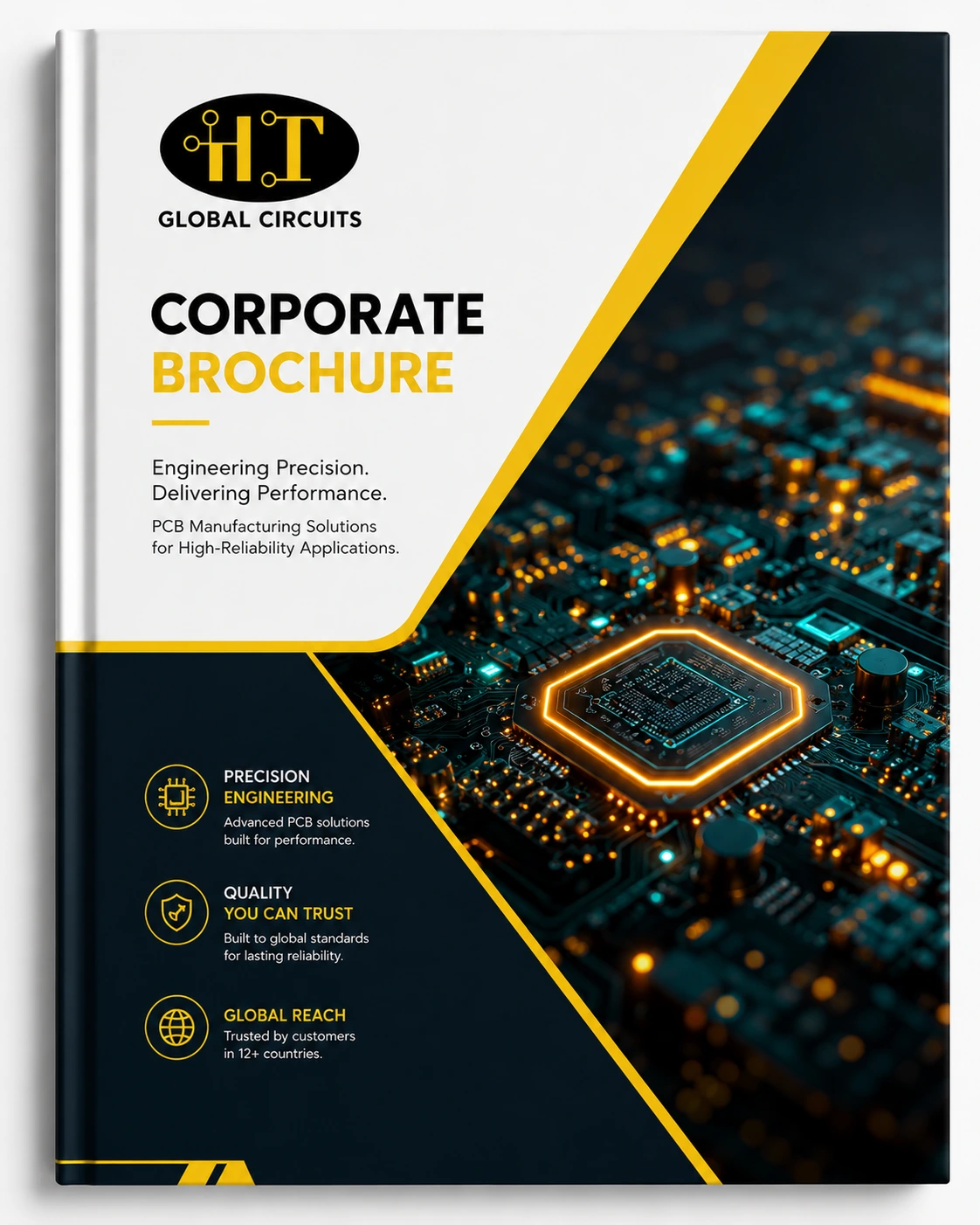
HT Global Circuits Corporate Brochure
Engineering Excellence. Global Manufacturing. Proven Reliability.
Learn how HT Global Circuits supports OEMs worldwide with advanced PCB manufacturing solutions. Our company profile provides a concise overview of our manufacturing capabilities, engineering expertise, certifications, global supply chain, and industry experience – all in one professionally designed brochure.
36+ Years Experience
Quality Certifications
400+ OEM Customers
Global Network